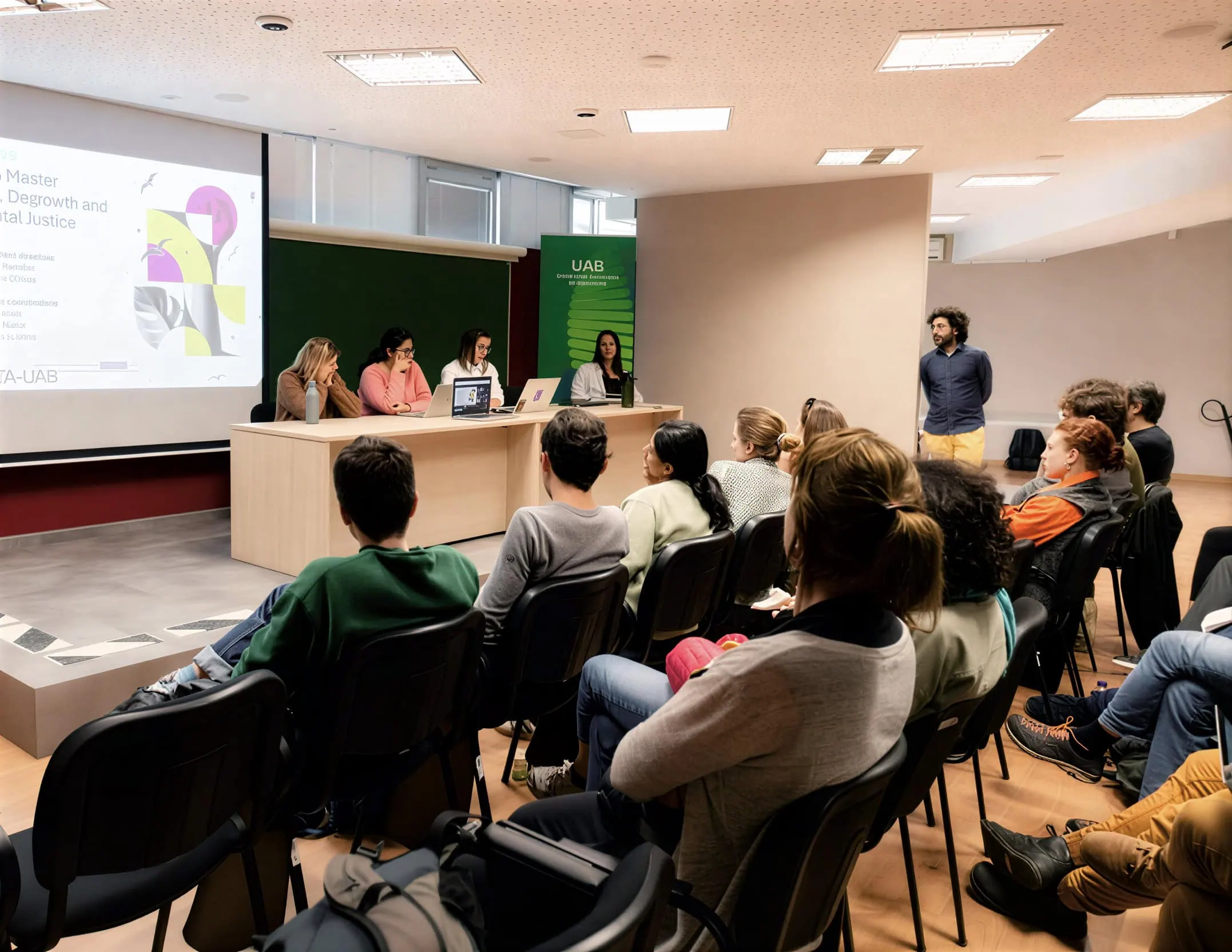
This is the 9th edition of the first master's degree in the fields of Political Ecology, Degrowth and Environmental Justice.
The master's is co-organized by the Institute of Environmental Science and Technology at the Autonomous University of Barcelona (ICTA-UAB) and Research & Degrowth International (R&D), bringing together the scholarly excellence of ICTA-UAB researchers with hands-on experience in activism and policy-making of R&D’s networks. Its content is designed to respond to the current era of unfolding ecological breakdown, the interrelated crises of growing inequalities, poverty and environmental disasters and their common root - the growth imperative of capitalist economies.
Key Info
Giacomo D’Alisa
UAB Alumni discount: €3564
Presentation
The master's provides a holistic understanding of environmental and social problems as interconnected and linked to the uneven distribution of power under capitalism, requiring profound systemic change. This program aims to equip students with the knowledge and tools to think critically and to bring forward such change effectively. We aspire to train the next generation of environmental justice activists, engaged civil servants, and entrepreneurs of the cooperative economy - those who will put into action the best ideas for creating a fair, enjoyable and ecologically sustainable society.
The restructured edition includes the following main changes: Firstly, the integration of more critical and feminist Political Ecology and ecofeminism. Secondly, a focus on decolonizing degrowth and linking it to post-colonial ideas and the pluriverse, a concept that refers to alternative traditions and proposals for human development from the Global South. Thirdly, a new subject, the Barcelona School of Ecological Economics and Political Ecology, that is composed of a series of seminars that demonstrate the range of research lines by ICTA researchers, such as Indigenous and local knowledge systems, Environmental conflicts and extractivism, Conservation and Real Existing Degrowth. It is important to note that most of the teachers are researchers from and trained in Europe and the Global North though.
Our program is enriched by its Barcelona “activism” location, the capital of Catalonia. It is a city and country historically at the forefront of experimentation with the commons, social and solidarity cooperatives and community economies. We have developed close collaborations and partnerships with several civil groups and cooperatives in the city and its metropolitan region.
We benefit from having a network of 'living labs' in the Catalan countryside, where degrowth is practised and experienced in a rural setting.
Who It’s For
The course is ideal for those who want to learn more about Political Ecology, Degrowth and Environmental Justice, either after their bachelor’s degree, or after they got a master’s degree on a different topic or even started a PhD, and want to shift towards research on degrowth and environmental justice. The master’s is a “Master Propio” and hence does not lead to a PhD though.
Program
Coordinator: Marta Conde
- Political Ecology (Diego Andreucci, Santiago Gorostiza)
A critical introduction to the interdisciplinary field of Political Ecology, the study of how power affects socio-environmental relations and processes. It offers a global view of the current ecological crisis and its political, economic, cultural, historical and epistemological dimensions and interconnections. It will explore theoretical frameworks and key concepts underlying the contemporary political and ecological critique of capitalism and development. - Socio-Environmental Conflicts and Environmental Justice (Marta Conde Puigmal, Sara Mingorria)
Introduction to main causes, traits and strategies of resistance in environmental conflicts through the environmental justice atlas. Together, we will explore the current colonial critique of environmental justice and transition ideas, looking instead to emancipatory locally led resistance processes. We will analyse the role of science and scientists in these conflicts. - Feminist Political Ecology (Federica Ravera)
Provides a basic understanding of core feminist concepts and analytical tools needed to (a) explore the hetero-patriarchal dimensions of the socioeconomic system and the “growth society”; and (b) examine the gender dimensions of environmental justice and conflicts. Ecological economics is revisited from a feminist economics perspective. And ecofeminist contributions enrich and expand degrowth both as a discipline and a social movement.
Coordinator: Brototi Roy
- Introduction to Degrowth (Giorgos Kallis)
Introduction to the history and sources of Degrowth, the current state of research and the future ahead. - Biophysical limits to growth (Salvador Pueyo)
An explanation of the environmental source of Degrowth, including the law of entropy and biophysical limits to growth, decoupling and the links with biodiversity loss, climate crisis etc. - Capitalism, colonialism and growth (Jason Hickel)
An explanation about the links between capitalism and colonialism, with a focus on unequal exchange. This section focuses on debates around global poverty and inequality to think of a degrowth future from a southern perspective. - Well-being and Degrowth (Filka Sekulova)
An introduction to well-being as a multi-dimensional concept, and a theoretical and empirical lens in thinking and planning around Degrowth. - Decolonizing Degrowth (Brototi Roy)
An introduction to the post-development critique and linking ideas of decolonial thinking and action with Degrowth.
Coordinator: Giacomo D’Alisa
- Introduction to the Barcelona School of Political Ecology and Degrowth (Giacomo D’Alisa)
Introduce the history of the Barcelona School of Political Ecology and Degrowth and the core concepts and approaches it has developed since its emergence, e.g. language of valuation, ecological distribution conflict, environmentalism of the poor, post-normal science, degrowth. - Societal Metabolism (Marcel Llavero Pasquina)
Introduce the theoretical concept of societal metabolism and its applied role within the studies of environmental conflict, Political Ecology and Degrowth. - Conservation (Sara Mestre Andrés)
Present the neoliberal conservation logic, its key processes, and implications. Critical assessment of the habitat banking policy that promotes offsetting impacts on biodiversity of development projects. - Extractivism (Roberto Cantoni)
Explain the drivers and determinants of the expansion of extraction frontiers; ecologically unequal exchange, world systems theory and the globalised neocolonial economy; extractivism and environmental conflicts; the end of extractivism. - Indigenous knowledge and resistance (Álvaro Fernandez Llamazares, Sandrine Gallois)
Present indigenous perspectives on the current social-ecological crisis, scholarship approaching environmental justice through an indigenous lens, and the contributions of indigenous knowledge to the fields of sustainability and Political Ecology. - Real existing Degrowth (Marula Tsagkari)
Present Degrowth and post-growth practices and experiences. Introduction of the concept/ typologies of real existing degrowth and discussion of specific cases. - Urban Environmental Justice (Panagiota Kostila)
Unpack the urban and urbanization as a process whereby environmental and social change co-determine each other. Introduce Urban Environmental Justice and discuss recent urban re-naturing and climate adaptation interventions as power-laden and contested.
Coordinator: Claudio Catteneo
- Experiential Practice of Degrowth (Michael Duff, Francois Schneider, Claudio Cattaneo)
Practically-enabled learning through exposure to attempts at embodied, transversal, degrowth living via visits to specific rural Living Labs (Can Decreix, La Bruguera, Picamoixons). Development of a personal, experiential degrowth plan, examining obstacles to change (e.g. personal, cultural, systemic, economic and more). - Activism in Barcelona (Claudio Cattaneo, Sergio Ruiz Cayuela)
History of social and environmental activism in Barcelona with visits to landmarks for the city’s social movements. Presentations from city activists and theoretical classes on issues of activism. - Embodiment, movement and art-based expressions of Environmental Justice (Maria Heras, Carlo Sella)
Introduction to the role and potential of artistic expressions in activist research, education and action around Environmental Justice and Degrowth. Students will actively participate in a reflective, experiential learning process through an embodied approach based on movement, participatory theatre and process work.
Coordinator: Angelos Varvarousis
- Introduction to the commons (Giacomo D’Alisa)
Introduces the study of commons by drawing on three perspectives: the institutional school of Elinor Ostrom, Political Ecology and economy of the enclosure, and digital commons and the disruptive potential of peer-to-peer collaboration. - Rural commons (Sergio Villamayor)
Takes an institutional and Political Ecology perspective to introduce the management of natural resources as led by local communities. It focuses on “traditional” natural resources such as forests, water and fisheries, and more recent ecosystem and landscape services. The course also discusses the pros and cons of “governance by communities ”, as compared to the role of governments and markets, and possibilities for integration. - Urban commons (Iolanda Bianchi)
Explores the relationship between commons and the urban context. First, it examines how distinct urban processes affect the development of commons in cities, showing how these processes offer ambivalent political possibilities for urban commons. Second, it presents cases of commons across different urban geographies, dwelling on the case of Barcelona. Third, it explores the link between commons and urban policy-making, presenting some commons-inspired co-production arrangements adopted by different European local governments. - Digital commons and P2P production (Alex Pazaitis)
This course is a theoretical and hands-on exploration of the theory and practice of online and offline collaboration and sharing. The goal is to engage in a critical discussion of the internet-enabled collaborative initiatives. Students will engage in multi-disciplinary literature about digital commons and their hidden socio-environmental costs. - Support structures and geographies of the commons (Angelos Varvarousis)
This course aims to synthesise the lessons of the previous courses and apply them to concrete geographies. To achieve this goal, students will work in groups on the gamified educational platform upstream, which is a tool for analysing and transforming existing city-regions and other similarly scaled territories in the direction of the commons. The process is divided into four parts: in the first phase, students choose their area of research and, through the use of play-cards, analyse the existing support structures that may facilitate such a transition. In the second phase, they seek to understand the connections and the dynamics between these support structures with an emphasis on the factors that foster or hinder their co-evolution. In the third phase, they seek to read their map of supporting structures from different perspectives in order to understand and unveil missing elements and potential problems. In the final phase, they attempt to reshape the future through back casting methods.
Coordinator: Ksenija Hanaček
- Research design (Esteve Corbera)
We will introduce the fundamental pillars of scientific enquiry, including the main epistemological traditions, suggest possible avenues to identify a broad research topic and relevant research questions, and discuss the characteristics and challenges of conducting multidisciplinary environmental research. - Ethics, positionality and participatory research (Ksenija Hanacek)
Introduction to research design and overview of ontologies and epistemology with positioning, reflexivity and ethics; qualitative, quantitative methods and mixed for data collection, questions research and objectives located in each method; data analysis; plural forms of knowledge through a critical, participatory and decolonial lens. - Qualitative Methods (Simona Getova)
Development of different qualitative research designs, data coding and interpretation of results. Integration of participatory and arts-based qualitative research, workshops, and writing. - Q-Methods (Christos Zografos)
An introduction to Q, a mixed methodology to identify discourses, attitudes, and social narratives using a small number of interviewees. The course will teach students how to design and execute a Q study, from identifying salient statements and respondents, to analysing data and presenting findings. - Survey (Sergio Villamayor)
The course is taught as a “practicum”, i.e. theory about how to design and implement a survey is linked to exercises to solve practical problems. Students will become aware of the importance of participation when designing surveys; familiar with basic biases to avoid when designing surveys, knowledgeable of basic sampling theory, acquire hands-on experience with the design of questionnaires and knowledge of best practices, aware of the opportunities and challenges of in-person, phone and online surveys; familiar with basic survey data analysis strategies. - Integrated Assessment (Raul Velasco Fernandez)
Hands on practice with quantitative assessment techniques such as social multi-criteria evaluation and MUSIASEM (multi-scale integrated analysis of societal and ecosystem metabolism), including participatory designs of doing research.
Coordinator: Monica Garriga
- Facilitation Technique (Mar Maiques Díaz)
This course introduces group cohesion facilitation, horizontal decision-making processes, conflict resolution practices and creative tools to get there. - Campaigning (Emma Avilez, Rakel Muñoz)
This course teaches how to design and build an activist campaign both from an organization’s perspective and from grassroots. special emphasis on communication techniques and political strategy. Activist collectives will be invited to participate. Methodologies like theory of change, audience understanding and storytelling will be part of the module . - Setting up a cooperative enterprise (Andrea Calsamiglia)
This course aims to learn the practical aspects of setting up an enterprise in the social, solidarity or collaborative sector. Professionals from the sector will be invited to participate. - Promoting open community economies (Mònica Garriga)
This course explores how to set up open sustainable projects with the community that is targeted. Using the commons sustainability model as a way of collectively solving the needs of people.
Coordinator: Ksenija Hanaček
Option A: Scientific research with either an academic output (i.e. an academic paper) or a non-academic output (i.e. an opinion article for a national or international newspaper).
Option B: Project through a practicum in an organization contributing to a more socioecological society.
You can present your TFM by September, or extend your master’s until March of the following year.
Do you want to learn more about applications?
The applications for the 9th edition (2026/2027) are open until May 31, 2026.
For following editions, please follow our website and social media for the opening date.
The admission process serves to ensure that all students meet the program’s requirements and thus guarantee an optimal work environment during the course. To apply for admission you can do it online or in person, and in both cases, you will need to provide the required documents. This will be done by applying through the UAB platform. On the UAB interface, you will register and once you receive notice of admission, then there is another step called enrolment. More info below.
Lecturers
Organizers
This master’s is co-organized by ICTA-UAB (Institute for Environmental Studies and Technology at the Autonomous University of Barcelona) and R&D (Research and Degrowth International) in Barcelona.
The Institute of Environmental Science and Technology (ICTA) is a multidisciplinary centre that promotes academic research and postgraduate education in the environmental sciences, which includes contributions such as the atlas of environmental justice. It aims to improve our understanding of global environmental change, and the nature and causes of environmental problems. In addition, it studies policies, strategies, and technologies to foster a transition to a sustainable economy. It leverages the ongoing European Research Council synergy project on post-growth (REAL), currently the largest degrowth-oriented initiative in Europe.
Research & Degrowth, (R&D) is a think-and-act-tank dedicated to the radical transformation of our economies and societies through research, advocacy, education, training and events around degrowth. It draws upon over fifteen years of successful organizational experience in international Summer Schools focused on Environmental Justice and Degrowth. R&D defines degrowth as a multi-level voluntary path towards reduction of production and consumption aiming at ecological sustainability, good life, liberty, and social justice. For R&D, degrowth is grounded in ecology, ecological economics, anthropology, psychology, and social sciences in general. In the degrowth process, R&D is concerned with democracy, international cooperation, and understanding as opposed to societal closure, fragmentation, and authoritarianism.
FAQs
for Application Process and Scholarships
Admissions for the 2026-2027 academic year are open until May 31, 2026. Students are advised to apply early on.
Yes. This is an indispensable document. Please read the formal requirements of the bachelor’s degree here.
No. The official Bachelor's degree is an indispensable document to get accepted into the master's by UAB.
You can apply to the program through the UAB platform (more information here). You will be required to attach the following documents in PDF format:
Currículum Vitae - CV with 2 contacts for references
University Degree Title (1) - Official Bachelor's certificate
Letter of motivation - Including your personal, professional and activist experience in PE, Degrowth & EJ (max 2 pages)
Certificate (2) - English proficiency certificate, this self-assessment is sufficient, as a native speaker any university certificate works
DNI / Passport/ NIE - Photo of the front and back of the first page of your passport/ national document
Optionally, you can add Bacherlor's transcripts, Master's certificates, certificates of other qualifications etc.
English proficiency is required because all classes are taught in English and students must be able to participate in the lectures and activities in this language.
For non-native speakers there will be proof of English required. Please take this self assesment test and include the result in your application: https://www.efset.org/?.
For native speakers, please upload any school or university certificate to proof your English proficiency.
All backgrounds are welcome to apply.
Every year we strive to offer up to two full scholarships (or 4 half scholarships) covering the tuition fee. The criteria to assign the scholarships are the following:
Be an activist
Affected by a socio-environmental conflict
People from low-middle income countries will be prioritized
In order to apply for a scholarship, you must mention this in your motivation letter and send us a separate email at
Letter explaining the need for a scholarship
2 letters of reference confirming you meet one or all the requirements referred to above and the need for a scholarship.
The regular tuition fee is €3960.
There are no discounts or differences attending to nationality.
Only people that are certified as Alumni UAB Premium (people that have studied before at UAB and that have done the process to become Alumni Premium) have a discount on the total fee and can pay €3564.
This is not an option at the moment.
Yes, at the moment of enrollment you have to chose between Professional Skills and Research Skills. It will also be possible to enroll for the second module as an extracurricular.
Make sure your documents have been uploaded correctly to UAB and you have received notice of receipt from the university. If you haven't received it, it is possible that your documents were not uploaded in the correct format, or you may have missed a step.
Acceptance will be communicated from our email address, along with payment instructions. Once you have received your acceptance, and completed payment you should perform final enrolment via UAB.
Please write to
You can contact the coordinator Jana Kenkel via our contact form.
FAQs
for Master Program and Classes
We plan to run the master 100% in-person in Barcelona. We do not provide help with accommodation. For the visa procedure, we provide a letter of admission/enrollment once you have been accepted into the program.
Here you can find the program of the current edition of the master: https://master.degrowth.org/studies/master-on-political-ecology#studies-program
An updated program for the 2026-2027 academic year will be made available in the summer of 2026.
The official starting date of the master’s is October 1st, 2026.
Taught classes end in June.
In order to finish the master’s, you have to present your final master’s work. There are two calls. The first call is in September which means you do your final project over summer.
There is also the option to ask for an extension which runs till March of the following year, which most students choose. In that case, the master runs for 1,5 years until March of the following year.
There is no problem with doing another master at the same time. Just be aware that you have to attend classes and have enough time to perform well in both courses. Also, note that there will be no concessions or exceptions made due to the fact that you are studying for two master’s degrees.
Also we do not encourage full-time working and studying at the same time, although everyone's needs will be different.
Normally, classes are scheduled in the morning, between 10:30 and 13:30h, and afternoon between 15:00 and 18:00h. Weekly there are up to five classes, two or three hours long. Additionally, there are optional seminars.
This page answers the question in detail: https://www.uab.cat/web/studies/graduate/what-are-the-differences-between-an-official-master-s-degree-and-a-uab-specific-master-s-degree-1345713249545.html
Our pedagogy is based on a combination of lecture-style, cooperative learning and hands-on experience. You will be asked to read and write academic texts and learn through field visits and engagement with grassroots initiatives focused on ecologically sound and socially fair transformative practices. Group work is meant to hone your teamwork skills and peer-to-peer competencies. therefore, students will be asked to develop most of their assignments collaboratively.
Our Master does not lead to a PhD. It is a professional program, a “Master Propio”, meaning a Master granted by our University. Within Spain (and most of Europe), “Master Propios” are recognized by the private sector, but do not make you eligible for entering a PhD program in Spain (this might not be the case in other countries though where a master’s is not requirement for entering a PhD program). You can learn more about the difference here.
Yes, you can contact Fundació Autònoma Solidària via https://www.uab.cat/fas/. The fundation is there to support that every person, independent of their disability or specific educational needs can access higher education with equality of opportunity and enjoy a full academic and social life and autonomy at university.