
Our Alumni & Community
This page is about what happens when people come together around a conviction for justice and a liveable planet: the work they produce, the networks they build, and the futures they're making visible.
What happens when you study degrowth?
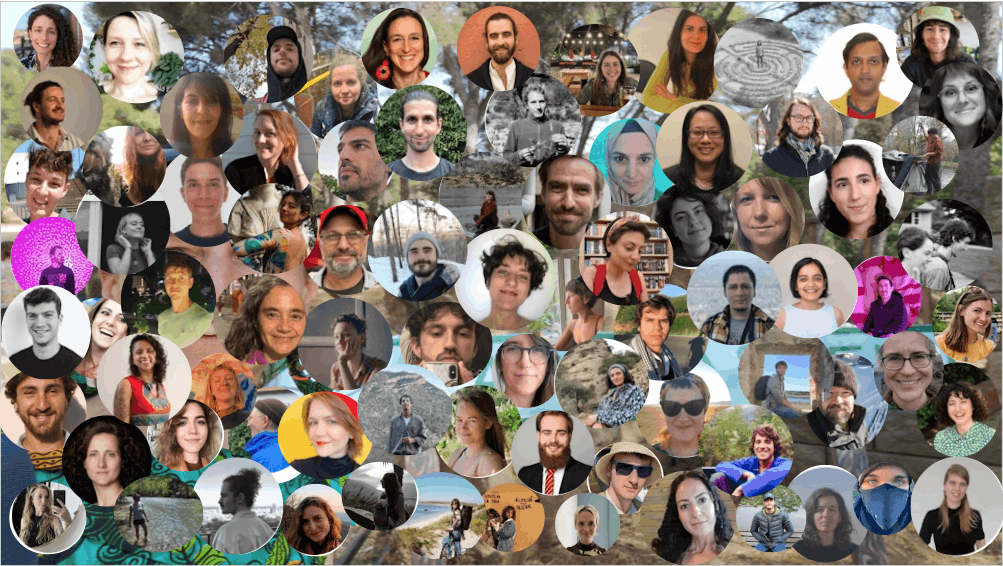
Our alumni go on to work in policy, activism, research, cooperative economies, journalism, and beyond, often combining several of these at once. They come from over 40 countries, from backgrounds as varied as biology, business, media, psychology, grassroots organising, and yes, even growth marketing. What they share is a commitment to building societies that are just and viable for the regeneration of life.
This page showcases the work they created, the TFM festivals where they presented it, and the network that keeps them connected.
What can you do with a degree in degrowth?
It's the question we hear most often. In 2024, Grist and Cass from The Green Fix teamed up to answer it, following graduates from both programmes into the job market and beyond. The piece features alumni working in European Parliament policy offices, founding community organising networks in Seattle, building cooperative food systems in Catalonia, and bringing degrowth thinking into PhD research in Brazil.
"I don't think that it's because we studied degrowth that now we're lost. It's more the opposite: figuring out how to work toward the world we want to see." — Emilie de Bassompierre, alum
ECOPOL Symposium Master's in Political Ecology
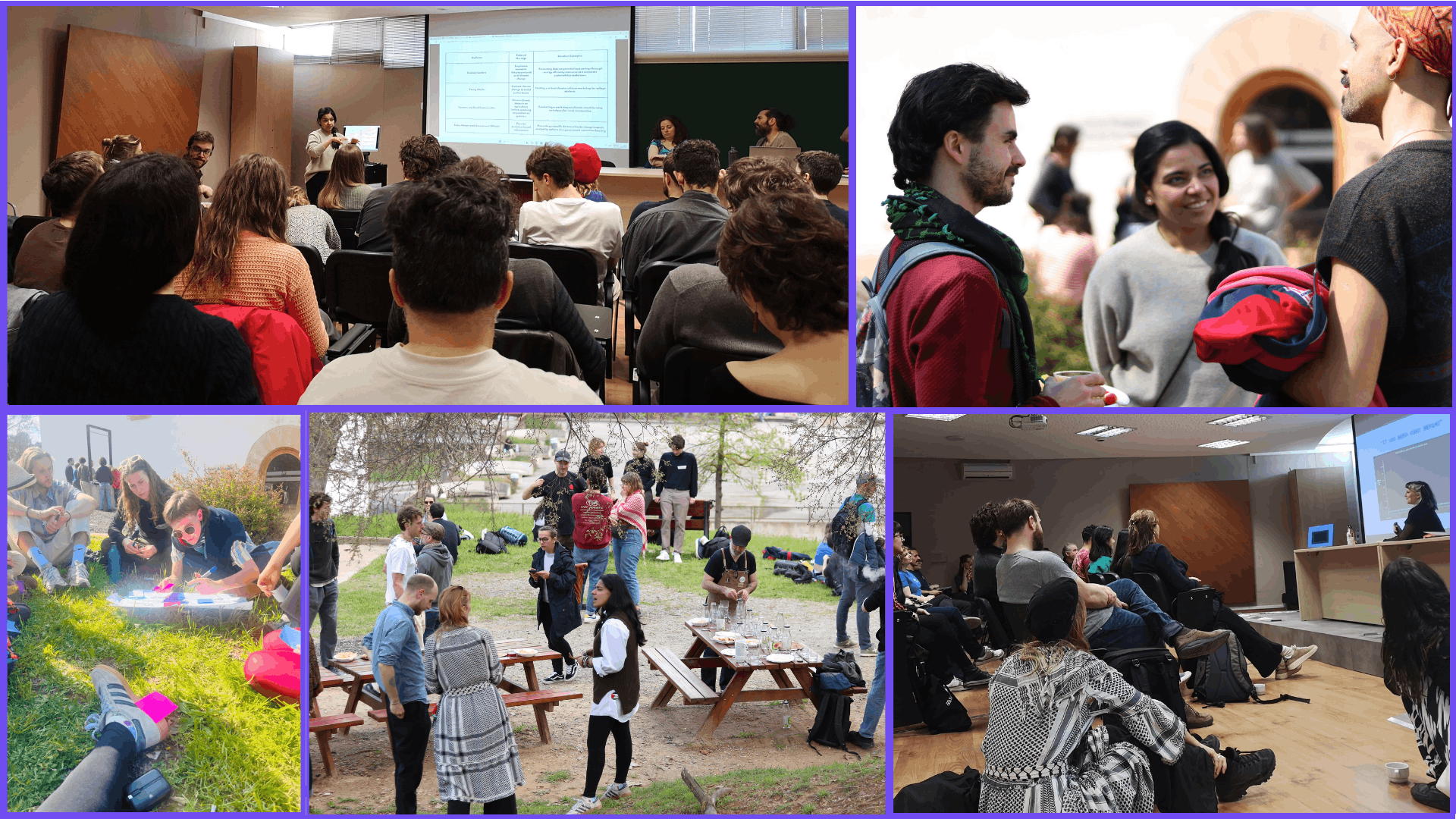
Each year, students from the in-person Master's in Political Ecology present and defend their final thesis projects at the ECOPOL Symposium. Held over three days in March on campus at UAB, the symposium brings together students, faculty, activists, and practitioners for a dynamic mix of research presentations, artistic work, and collective debate.
See last years festival programme →
Alumni Testimonials
Mariona - Catalunya, Spain
I studied economics because I wanted to understand how society managed the resources we have, and it was very disappointing because the way that they teach economics is very disconnected from resources and so it was just at the end of the degree that I had like 1 subject on natural resources and I felt very disappointed in that sense when I got my degree.
To me degrowth is to understand that as a society we need to change, we cannot keep going this way with this idea of the economy that comes especially from the global North and we impose it onto the global South – how they have to develop or what it means to be a healthier or wealthier economy – all these ideas that come from Northern countries.
If you recognise yourself as someone who needs to participate in society in a different way than through social media, and that the current system is not giving you this opportunity, this master is providing you just that. It’s providing you more ways to feel stronger or having more arguments to defend this position on how bad things are, or how bad this system is functioning.
Any person that feels like this, and it doesn’t matter where they come from or what they have studied or their age – it’s not important. We share this feeling of change. That’s what I feel, if you really think that you want to improve this world in this way, taking care of people and understanding that capitalism is not the priority but rather humans and animals and other beings. Then this masters is for you, for anybody.
Manuel - Austria
Before I came here to do this masters I’ve been active in the climate justice movement for years, and there we are very concrete when it comes to our actions – like blocking a coal pit, shutting down a coal power plant, stopping airport expansions – our demands are very very concrete.
But what I didn’t really know for myself or also sometimes we didn’t know in the groups where I was active in, what should come afterwards? What comes after we overcome capitalism and the system that is destroying the planet? And that’s when I came across degrowth and for me it sounded very very right and to approach this big question through the central thing that’s within capitalism which is the growth imperative.
I think this masters really is something for people who want to change the world. This sounds very big of course, no one of us will change the world with one idea, or one action, but I think every one of us can and has to contribute something to the bigger change. And I think that’s what we want to do and that’s what the masters can give you, because there are so many different ideas, so many different approaches within the degrowth frame, there is something for almost everyone.

Anna - Peru
I’m a journalist and most of the time I was working with indigenous people and different cultures in Peru. And I developed this kind of relationship with these people and I think that I started to know a lot of, to know this connection with the earth and it makes me reconnect with my own roots.
With this Masters I discovered that this kind of relationship that we have like in a natural way is very important. Because we respect other beings and also Nature. Taking this Masters you realise that it’s very important and you can find new ways of growing without growing economically and respecting other beings and nature and this interconnection that makes possible life on this planet.
I would recommend it to all people that are in this search of discovering themselves and what they are doing here on this planet. And how to be more connected between others, respecting other cultures and becoming aware of their own being.
I think that the most important thing for me in this Masters are the people that I met in the Masters. They come from different cultures but at the end they are asking maybe the same questions that I was asking myself. And we are trying to find out how to live in a more respectful way in this, on our earth. So I think that this is the most important thing.

Bruno - Brazil
I’m doing a PhD in marketing in sustainability – actually very different from Degrowth. But when I chose the theme of my thesis I chose to study degrowth because I think it’s an extreme position, but people don’t know anything about it. And I want to understand how consumers can actually adopt degrowth behaviours in their daily life. And to do this thesis in Brazil (I’m Brazilian) we don’t have a lot of studies in degrowth. Actually I didn’t find any until I got here.
I don’t think that the masters must be only for degrowthers or people that already know these issues. It’s really really nice for these people but I think it’s for everyone. I think about me, I’m from business and I think everyone could learn a lot with the masters. Actually, I think that if we don’t have any understanding about political ecology or this kind of thing, we have like a better transformation, a better change in your thoughts about the environment and about life itself.
Jaume - Catalunya, Spain
I saw this masters as an opportunity to bring together all the three aspects I do in my life. The first one about my background in biology studies in the university in which I was after studying I was working for 7 years in the Catalan government in the natural park area. And this masters is an opportunity for getting more information for pushing the government, for lobbying the government to improve its policies and also an opportunity for getting in contact with people that are actually doing research in those areas of conservation, climate change and so on.
On the other hand I have my activism and social movements, especially in Ecologistas en Accion. I’m pretty involved in different campaigns and actions especially in the areas of biodiversity conservation – not as a professional but as a volunteer. And this masters is pretty useful for getting a more theoretical basis for knowledge for improving the quality of our campaigns and also the information that we can use for supporting our campaigns and for giving them more strength for communicating our proposals.
And on the third hand I’m also actually working professionally in the area of organic food and social or cooperative economy. I am a part of a coop that is a shop that sells organic food, healing herbs and so on, and we see and I personally see this as an opportunity to build alternatives to the capitalist mainstream economy. And in the masters there is also a strong part of analysing how capitalism works and how some alternatives can be built against capitalism.
For me the most interesting part of the masters is the level of, let’s say debate, or the ideological debate we can develop in classes I mean. We receive a lot of information but we are instigated to debate and to discuss almost everything that is given to us in classes and to build our own ideas about it.
Some people are very for the degrowth movement, others are very skeptical about it. Some people are very strongly for a new ecological model of the economy, others not against the mainstream economics but do see the contradictions but are not against it like a revolutionary. So I think this masters gives us students the opportunity to discuss, to think profoundly about many important issues in society, in economy, in environment and environmental sciences and to get deeper, much deeper than in other courses. Because it’s mainly for, not for teaching knowledge specifically but also specifically for reflecting and trying to imagine a new society, getting the tools for imagining a new society. And this is why this masters is special for me.

Sandra - Slovenia
I’m not even sure if I should say that but I never heard about degrowth before. This was new to me. I took it because when I was doing my BA I wrote my final project thesis on Environmental Justice, so this was something that I just wanted to do, see what has changed after 10 years in the field of environmental justice.
I would definitely recommend it. First of all I don’t know maybe this is my experience because I studied like a long time ago, I’m not of the same generation like most of the master students are, but in my time you couldn’t have any kind of relationship with the professors – you were the students they were the prof there was a barrier and that was it. They came, they did their classes, you did the exam and that was it.
And here it was more like, I had the feeling how it was designed to make us like a little happy community to talk, that we could actually talk with them about everything. This is definitely something very new for me and I like it that it’s so open so that it gives you a lot of opportunity to find your inspirations in different fields but you can still relate it to the masters, so this is, I would definitely recommend it to all the people who are open minded.
I learnt how important it is to listen to people and how the generations that are coming have more to say about everything, they have an opinion about everything. I would say I learnt how important it is to take into consideration how generations can differ and maybe to try to be more I would say respectful for each person and give them the opportunity they deserve, to avoid different kinds of conflicts and clashes because I think this is what I think we encounter in everyday life so this was a valuable lesson to me – how to maybe react with less ‘me in my mind’ and more of the one I am speaking to or who is speaking to me.

Humans of Degrowth
When Nathalie Roy started the online master's in 2021, she didn't know if she'd finish. "On more than one occasion, I considered giving up," she writes in her final thesis. "It has taken immense perseverance to keep going."
Thankfully, she kept pushing and her final thesis project became a beautiful living portrait of this community.
She interviewed alumni from seven cohorts, across both programmes, from every continent. She asked them why they came, what changed, what they're building now. Their stories are published on Humans of Degrowth.
"I embarked on this project with the belief that it could help showcase the beauty and diversity of the journeys undertaken by those engaged in societal transformation, offering a range of possibilities for others to begin or continue their own paths."
Read Nathalie's full thesis →
Explore Humans of Degrowth →
TFM Festival Master's in Degrowth
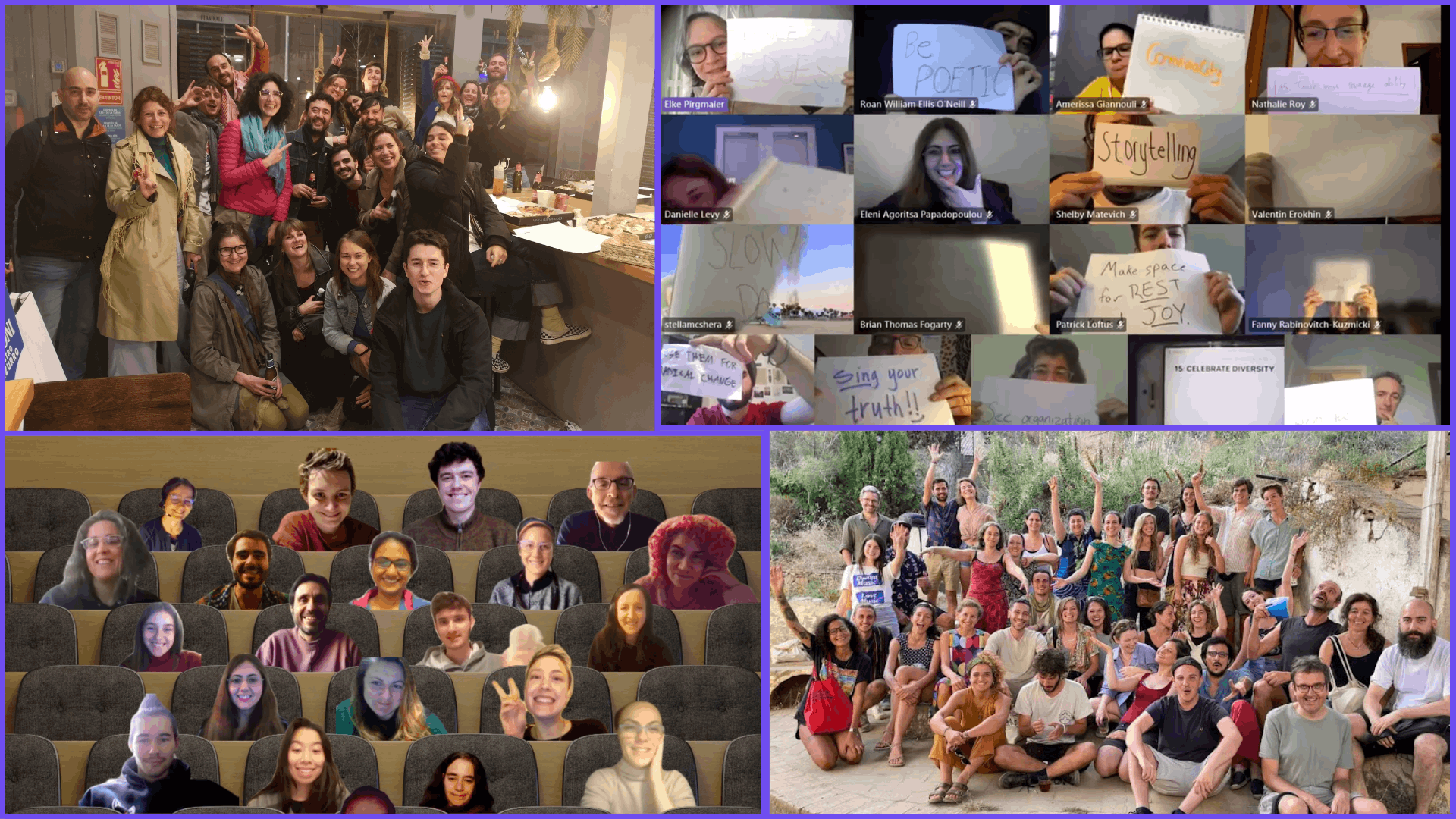
Each March, students from the Online Master's in Degrowth present their final thesis projects in a three-day virtual festival open to the public.
TFMs can take almost any form: a research paper, a campaign strategy, a community toolkit, a video documentary, a cooperative business plan, a podcast series, an activist manual, etc.
The festival is a space to share these projects, ask hard questions, and get a real glimpse of what degrowth looks like in practice. It's also a chance to meet the community behind the work: students, alumni, faculty, and practitioners from across the globe, exchanging ideas that don't fit neatly into a single discipline.
Some presentations end in debate. Others spark collaborations that last long after the festival closes.
Explore the TFM archive →
See last years festival programme →
Testimonials
Milica Kocovic De Santo - Serbia
As a PhD, scientific researcher, and university lecturer with seven years of experience in this field, I can unequivocally state that enrolling in the MA program in Degrowth, Ecological and Economic Policy at the Autonomous University of Barcelona was my finest professional decision.
The program connected me with an extraordinary international network of students and instructors who share my “immodest ambition” – changing the world. Through intensive interaction (classes four times weekly), we developed an incredible synergy that transcends the limitations of the online format.
From personal experience, I recommend part-time study rather than the full-time option I chose. Although I successfully completed the program within one academic year, this content-rich curriculum deserves more time for thorough examination, especially for those who are simultaneously working.
The most valuable aspect of the program is the community of “disobedient dissidents” who critically reflect on “dangerous” ideas that are, in fact, deeply humane. Fellow students and professors from all continents have become my intellectual family and inspiration.
The program has empowered me to launch new modules at several universities in Serbia, spreading degrowth ideas within our academic space. I warmly recommend it to anyone wishing to understand systemic dynamics from a perspective that challenges the status quo, regardless of educational level or professional experience.
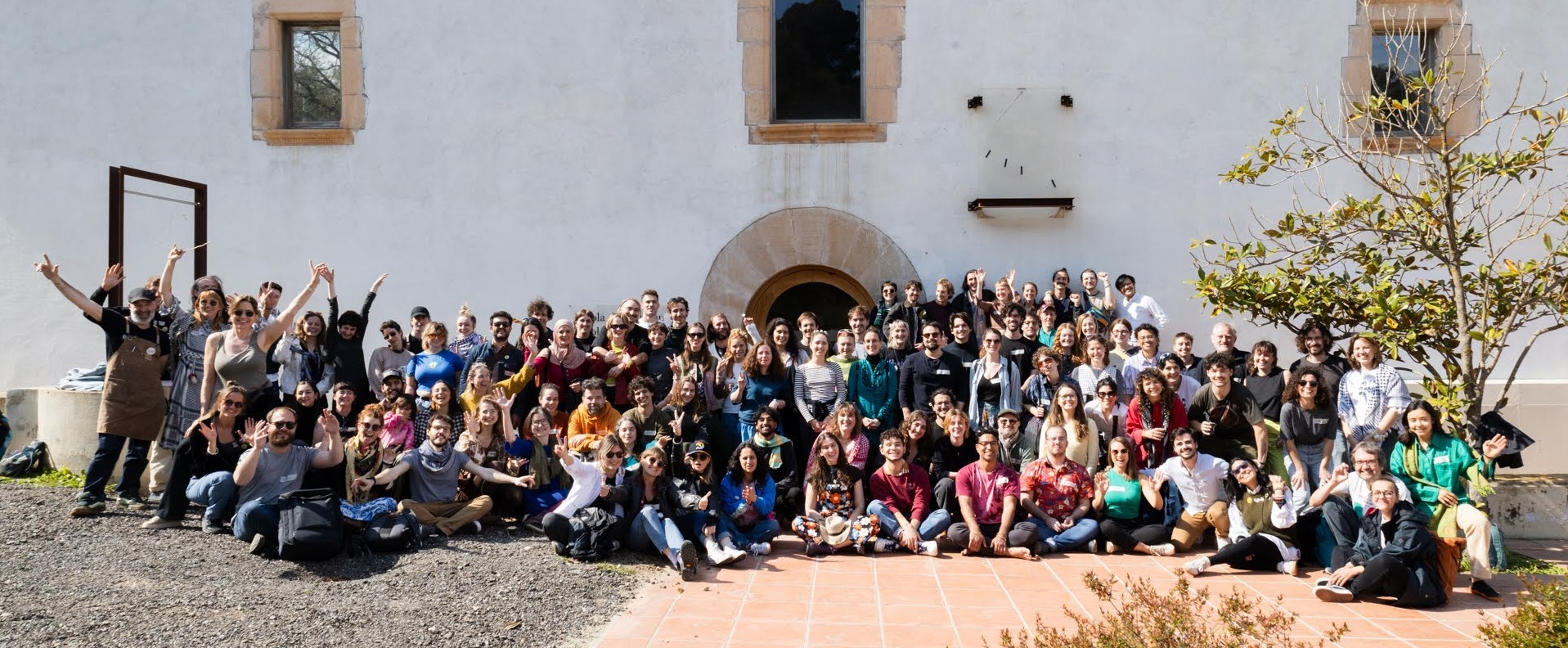
Once a year, the alumni of the Political Ecology Master and the Online Degrowth Master meet up in person in Barcelona to connect, discuss and share convivial moments.
Tim Linaberry - USA
I found the Online Master’s Program for Degrowth while on a desperate and disparate road, searching for answers to questions I have long-held. Discovering Degrowth felt intrinsically like recovering a missing segment to a puzzle that had once seemed unfinishable.
Being fortunate enough to be accepted into the inaugural online cohort, I was in awe as I was welcomed and connected into a global camaraderie that far outstretched the capacities of mainstream environmentalism in the US. The interdisciplinary material presented in the program should be a mandatory prerequisite for existence in the 21st century. The pluralistic perspectives and spaces that opened as I became a part of the online Degrowth community will forever illuminate a new path.
The future is together, and it is only with a sense of compassionate conviviality that we can learn to slow down and ecologically build ourselves a new route.
Gisela Ruiseco - Colombia
My intention since young years has been to try to understand why our societies have taken such a perverse course. Originally a social psychologist- interested in post-development and decolonial thought, I had always become more interested in environmental issues, agroecology and alternative economies. I eventually got to know the work of Joan Martinez Allier which eventually got me to master. Up to that point, I had been a part time essayist and columnist, writing in non-academic media. Also, in my private life, I have experimented with alternatives ways of living and agroecological local movements.
The reason for explaining all of this is to say that coming from a very eclectic background, I found in the master a very satisfying, very profound and rich spring of highly interesting discussions and literature, somehow organizing my previous various paths, giving me a profounder vision, and, perhaps specially, a prospect of possibilities for our societies.
If I had to highlight one aspect of the master I would say it is its multidisciplinary depth. This could seem a contradiction, but alumni can gain a bird’s eye view of many disciplines and at the same time a depth in their critical eye, questioning deeply what we take for granted, thus reinforcing the possibility to provoke deeper and necessary transformations.
The “we” in Degrowth is perhaps mostly a person socialized in modernity (/coloniality) but in a movement to reach beyond this: in itself a difficult undertaking, and as such also not exempt from conflicts. Degrowth is alive! And thus an exciting area to delve into. Highly recommendable to whoever wants to be updated about new ideas and ways to face the multiple crises in which we are immersed, how to re-understand ourselves and our societies and head for new, sustainable, just and plural ways of living.
Alumni Network
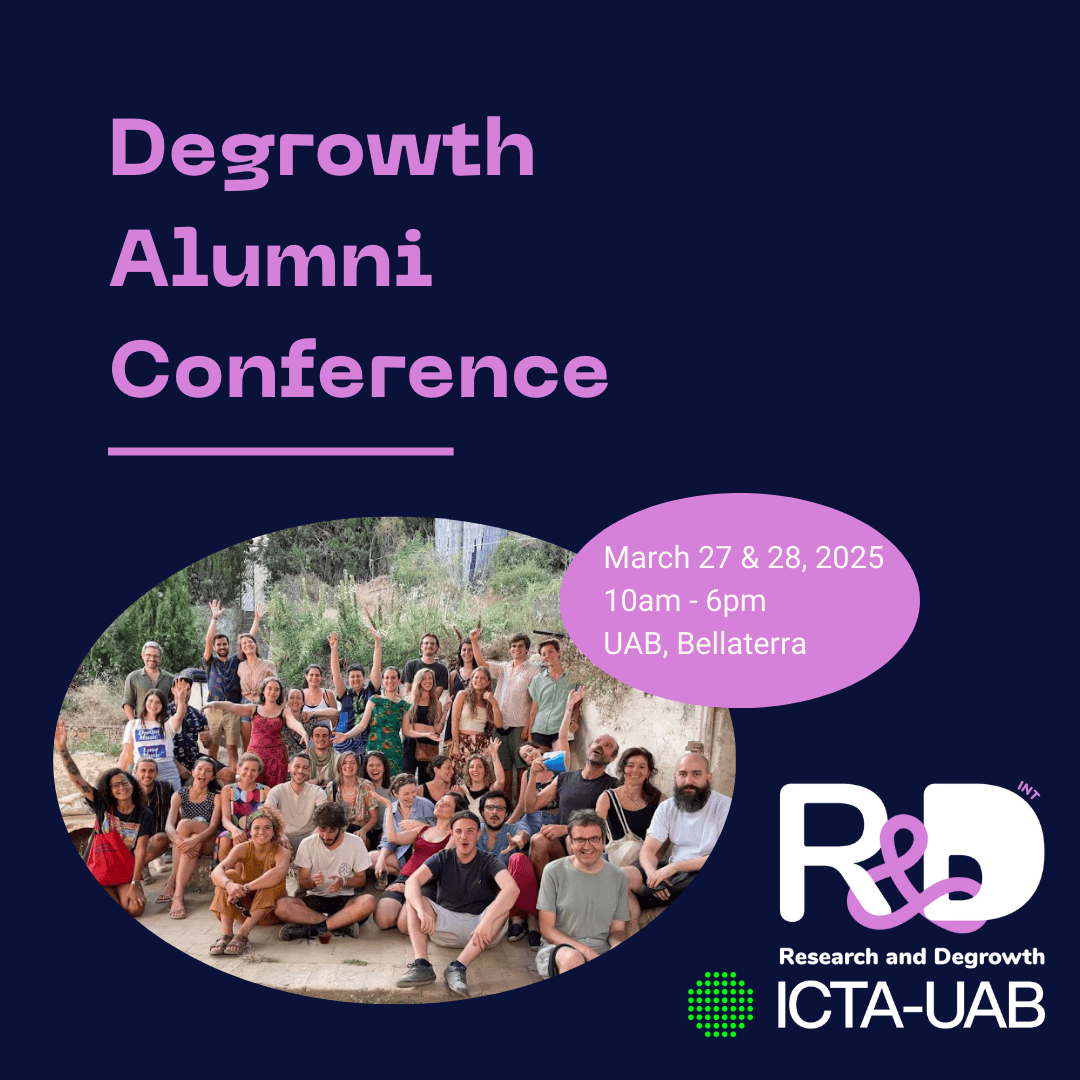
Over 500 alumni from a combined 13 years of both our programme are connected via the Degrowth Alumni Network.
Once every couple of years, the alumni of the Degrowth and Political Ecology Masters meet up in person in Barcelona to connect, discuss and share convivial moments.
The Degrowth Alumni reunion also brings together teachers, researchers and practitioners from both programmes, R&Di and ICTA-UAB.
Check out last years reunion programme!
Ready to join them?
Whether you're a recent graduate, a career-shifter, an activist, or someone who simply needs new tools to imagine a different world, there's a place for you here. Apply to our programmes and join our growing community!